How to Tell If a Food Is Actually a Good Source of Protein for Fat Loss
If you have ever stood in the grocery store staring at a label that says high protein and thought, okay but is it actually a good source of protein though… this is for you.
The word protein is everywhere right now. Protein cookies. Protein cereal. Protein ice cream. Protein granola. Even protein candy. And while I love that we are finally prioritizing muscle and strength as women, there is a big difference between a food that contains protein and a food that is actually a good source of protein.
If your goal is fat loss, body recomposition, or building a lean toned look, understanding this difference will save you so much frustration.
Today I am breaking down exactly how to tell if a food is truly a quality protein source, using a simple rule that you can apply in seconds.
Why Protein Matters So Much for Fat Loss
Before we get into the numbers, let’s quickly talk about why this even matters.
Protein is essential for:
-
Building and preserving lean muscle
-
Supporting metabolism
-
Helping you feel full and satisfied
-
Preventing muscle loss while dieting
When you are trying to lose fat, the goal is not just to lose weight. The goal is to lose fat while keeping as much muscle as possible. Muscle gives you shape. Muscle gives you that tight look. Muscle is what makes your body look different at the same number on the scale.
But here is the problem.
A lot of women think they are eating high protein because they are choosing foods that say protein on the front of the package. Meanwhile, their actual protein intake is not high enough to support their goals.
The reason usually comes down to protein density.
Related: Beginner Gym Guide for Women: The Exact Weekly Workout Plan to Transform Your Body
What Is Protein Density: Good Source of Protein
Protein density simply means how much protein you are getting per calorie.
This is the part no one teaches.
Two foods can both have 10 grams of protein. One might be 90 calories. The other might be 260 calories. Those are not the same.
When calories matter, especially during a fat loss phase, you want your protein sources to be efficient.
You want to pay as few calories as possible for as much protein as possible.
That is where the simple rule comes in.
The Simple 10 to 1 Protein Rule
Here is the easiest way to tell if a food is a good protein source.
For every 10 calories, you want at least 1 gram of protein.
In other words:
-
100 calories should give you about 10 grams of protein
-
150 calories should give you about 15 grams of protein
-
200 calories should give you about 20 grams of protein
This is what I call the 10 to 1 rule.
If a food meets that ratio, it is a solid protein source.
If it is even better than that, closer to 1 gram of protein per 8 calories, that is excellent.
If it is worse, like 1 gram of protein per 12 or more calories, it is not protein dense. It might still be a fine food, but it is not an efficient protein source.
Examples of Good Source of Protein Foods
Let’s make this practical.
Here are some examples of foods that are typically very protein dense.
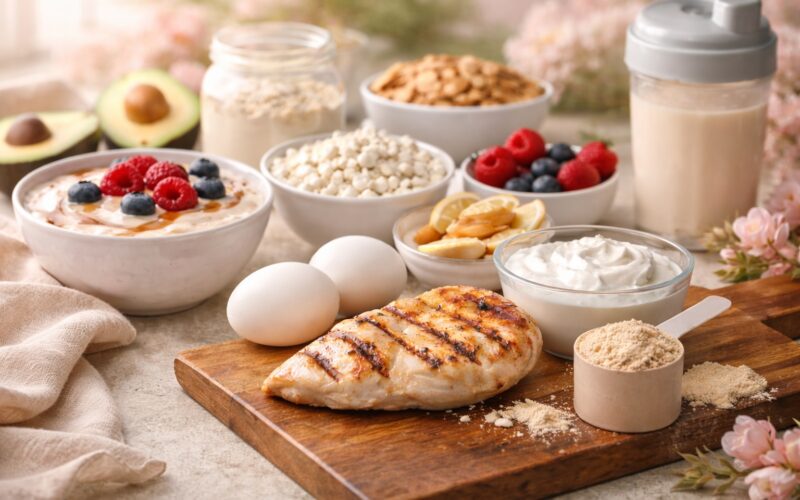
Egg whites
Nonfat Greek yogurt
Skyr yogurt
Chicken breast
Turkey breast
White fish like cod or tilapia
Shrimp
Whey protein isolate
Cottage cheese
Most of these fall close to or even better than the 10 to 1 rule.
For example, a typical serving of nonfat Greek yogurt might have 17 grams of protein for about 100 calories. That is excellent protein density.
A scoop of whey isolate might give you 25 grams of protein for around 110 to 120 calories. That is very efficient.
These are true protein anchors. These are foods you can build meals around.
Related: What are peptides? What do they do? The Ultimate Guide
Foods That Have Protein But Are Not Great Protein Sources
Now let’s talk about the foods that confuse people.
Peanut butter is the most common example.
Two tablespoons of peanut butter might have 7 or 8 grams of protein, but they also have around 190 calories. That is not a high protein food. It is a fat source that contains some protein.
Nuts in general fall into this category.
Protein granola bars are another example. Some of them have 10 grams of protein and 230 or 250 calories. That works out to about 1 gram of protein per 23 to 25 calories. Not protein dense.
Even whole eggs, while very nutritious, are not as protein dense as egg whites. A whole egg has about 6 grams of protein and around 70 calories. That is closer to 1 gram per 12 calories. Perfectly healthy. Not extremely efficient if you are trying to maximize protein on lower calories.
This does not mean you should never eat these foods.
It just means you should not count them as your main protein source if your goal is fat loss or body recomposition.
Why This Matters for Women Trying to Get Lean
If you are aiming for something like 120 to 140 grams of protein per day, but most of your protein is coming from foods that are not protein dense, you will hit your calorie limit long before you hit your protein target.
This is one of the biggest reasons women say:
I am eating high protein but I am not losing fat.
When we actually look at the numbers, they are eating foods with protein in them, but not enough total protein.
By choosing more protein dense foods, you make it easier to:
-
Hit your daily protein target
-
Stay full
-
Preserve muscle
-
Keep calories controlled
It is not about eating less. It is about eating smarter.
How to Read a Nutrition Label Quickly
Here is how you can apply this in real time.
Step one. Look at the calories per serving.
Step two. Look at the grams of protein.
Step three. Do a quick check.
If the calories are about ten times the protein grams, it passes.
For example:
180 calories and 18 grams of protein. Great.
200 calories and 10 grams of protein. Not great.
95 calories and 15 grams of protein. Amazing.
You do not need a calculator. You just need to glance and compare.
After a week of doing this, it becomes automatic.
Should Every Food Follow the 10 to 1 Rule
No.
And this is important.
Not every food you eat needs to be protein dense. Carbs and fats are important. Hormones need fats. Training performance needs carbs. Food should also be enjoyable.
The 10 to 1 rule is most useful for identifying your primary protein sources.
Each meal should have a clear protein anchor. That anchor should ideally meet the 10 to 1 guideline.
Then you can add carbs and fats around it intentionally.
For example:
Chicken breast with rice and avocado
Greek yogurt with berries and almond butter
Lean ground beef with potatoes
The protein source is solid and efficient. The carbs and fats are added consciously, not accidentally.
What About Salmon and Higher Fat Proteins
Some people ask about foods like salmon.
Salmon is higher in fat, so it will not be as protein dense as chicken breast. But it has healthy fats and is incredibly nutrient rich.
This is where balance comes in.
You can absolutely include higher fat proteins. Just understand that if most of your protein is coming from higher fat cuts of meat, it will be harder to stay in a calorie deficit.
If you are in a maintenance or muscle building phase, the flexibility is greater.
If you are aggressively cutting, leaner protein sources will make your life easier.
How Much Protein Should You Aim For
If you are strength training and trying to build or maintain muscle, a good general target is around 0.7 to 1 gram of protein per pound of body weight.
For example, if you weigh 140 pounds, aiming for 100 to 140 grams per day is reasonable.
Within that range, protein density becomes your best friend.
Instead of guessing or hoping your protein is high enough, you can structure your meals intentionally.
Common Questions About High Protein Foods
Is peanut butter a good source of protein
Not really. It contains protein, but it is primarily a fat source. Use it as a fat, not as your main protein.
Are protein bars good for fat loss
Some are, like these. Check the label. If the calories are much higher than ten times the protein grams, it is not very protein dense.
Is Greek yogurt better than regular yogurt
Yes, in most cases. Greek yogurt is strained, which increases protein and lowers sugar compared to regular yogurt.
Is whey protein necessary
No, but it is convenient. It is one of the most efficient ways to increase protein intake without adding many calories.
Can I build muscle without tracking this closely
Yes, but if you are stuck, plateaued, or frustrated, improving protein density is often the missing piece.
The Real Secret
The goal is not perfection.
The goal is awareness.
Once you understand protein density, you stop being fooled by marketing. You stop assuming a food is high protein just because it says so. You start choosing foods that actually support your goals.
It is a small shift, but it makes a huge difference over time.
When your meals are built around real protein sources, your hunger improves. Your workouts improve. Your body composition improves.
And you feel in control instead of confused.
Final Takeaway
If you remember one thing, let it be this.
For every 10 calories, aim for at least 1 gram of protein.
Use that as your quick filter.
Build your meals around protein dense anchors.
Add carbs and fats intentionally.
This is how you eat in a way that supports muscle, metabolism, and a lean toned look without obsessing over every single gram.
You do not need extreme diets. You do not need to cut out entire food groups.
You just need to understand what is actually fueling your body.
Once you do, everything gets easier.