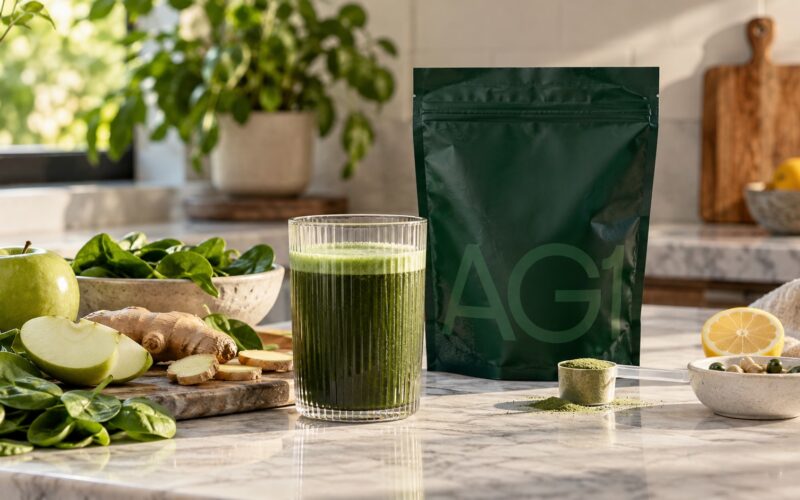
Is AG1 Actually Healthy for You? What the Ingredients and Science Really Say
If you’ve spent any time on Instagram or TikTok lately, you’ve probably seen AG1.
It’s that green drink people seem to be adding to their morning routines alongside their coffee, skincare, and workouts.
And with claims about supporting gut health, energy, and overall wellness, it’s easy to see why people are interested.
But there’s something I’ve been wondering about all these greens powders.
Is AG1 actually healthy for you, or is it just another expensive supplement that sounds better than it really is?
Because there’s a difference between a product containing healthy ingredients and a product actually making you healthier.
AG1 contains more than 75 ingredients, including vitamins, minerals, probiotics, prebiotics, and plant compounds. At $79 a month, it’s also a pretty significant investment.
So before adding another supplement to your routine, let’s look at what you’re really getting, what the research says, and whether AG1 is something you actually need.
Is AG1 Actually Healthy for You?
The short answer is yes, AG1 can be a healthy addition to some adults’ routines, but that doesn’t mean everyone needs it or will benefit from taking it.
AG1 provides a combination of essential vitamins, minerals, and other ingredients that may help support your nutritional intake.
For someone who struggles to consistently get certain nutrients through food, that could be helpful.
But if you’re already eating a balanced diet, meeting your nutritional needs, and taking appropriate supplements when necessary, AG1 might not provide much additional benefit.
Here’s something that often gets overlooked in supplement marketing:
Taking extra vitamins doesn’t automatically make you healthier.
Your body needs certain amounts of nutrients to function properly. Once those needs are met, consuming more doesn’t necessarily improve your health.
And in some cases, excessive amounts of certain nutrients can actually cause problems.
So rather than asking whether AG1 contains healthy ingredients, I think the better question is:
Does AG1 provide something your body actually needs?
That’s what determines whether it’s worth taking.
What Is AG1 Made Of?
AG1, formerly known as Athletic Greens, is a daily greens supplement designed to combine several types of nutritional supplements into one drink.
Its updated formula, AG1 Next Gen, contains vitamins, minerals, probiotics, prebiotics, and plant-based ingredients.
Unlike a traditional greens powder made primarily from dried vegetables, AG1 is closer to a multinutrient supplement with additional botanical ingredients.
A serving contains approximately:
| Nutrient | Amount per serving |
|---|---|
| Calories | 40 |
| Protein | 2g |
| Fiber | 2g |
| Vitamin C | 420mg |
| Vitamin B12 | 22mcg |
| Vitamin B6 | 3mg |
| Zinc | 15mg |
| Calcium | 118mg |
| Magnesium | 26mg |
| Potassium | 250mg |
Values reflect a published U.S. AG1 Next Gen Supplement Facts panel. Formulations may change, so always check the label on the product you purchase.
One thing that stands out is how much more AG1 resembles a vitamin supplement than a serving of vegetables.
For example, it provides substantially more than the Daily Value for vitamins C and B12, but only a relatively small amount of calcium and magnesium.
That doesn’t make it a bad product.
It just means you shouldn’t assume a greens powder provides meaningful amounts of every nutrient simply because it contains a long list of ingredients.
Let’s look at some of the potential benefits.
1. AG1 May Help Fill Nutritional Gaps
This is probably the most straightforward reason someone might benefit from AG1.
Even people who generally eat well can fall short on particular nutrients.
Maybe your meals aren’t always balanced. Maybe you don’t consistently eat a variety of foods. Or maybe your schedule makes it difficult to maintain the eating habits you’d like.
AG1 contains several essential vitamins and minerals that support normal bodily functions.
For example:
- Vitamin C contributes to normal immune function and collagen production.
- B vitamins help your body release energy from food.
- Zinc supports immune function and normal cellular processes.
- Folate plays a role in DNA production and cell division.
These are real functions supported by established nutrition science.
But there’s an important distinction.
The fact that vitamin C supports your immune system doesn’t mean taking extra vitamin C will automatically prevent you from getting sick.
Likewise, B vitamins help your body produce energy, but taking additional B vitamins isn’t necessarily going to make you feel more energetic if you already have adequate levels.
The most meaningful benefit comes when supplementation helps address an actual shortfall.
AG1 may help with that, but it isn’t the only way to get those nutrients.
A regular multivitamin could be an appropriate, less expensive option depending on your needs.
2. Is AG1 Actually Good for Gut Health?
Gut health is one of AG1’s biggest selling points.
And to be fair, there are some interesting ingredients in the formula.
AG1 includes probiotics and prebiotics.
Probiotics are live microorganisms that may provide health benefits when consumed in appropriate amounts.
Prebiotics are substances that certain beneficial gut microorganisms can use.
AG1 also contains plant-based ingredients associated with digestive health.
But here’s where I think we need to be careful with expectations.
Does AG1 improve digestion?
Possibly, for some people.
AG1 has conducted clinical research examining how its updated formula affects nutrient levels and the gut microbiome.
Some studies reported changes in certain gut bacteria and nutritional biomarkers.
That’s interesting, but changes in the microbiome don’t automatically prove that someone will experience less bloating, better digestion, or improved long-term health.
The science surrounding the gut microbiome is still developing.
And the effects of probiotic products can depend on the specific strains, amounts, and individual consuming them.
Can AG1 cause bloating?
Yes.
Ironically, something marketed for digestive health can cause digestive discomfort in certain people.
Prebiotic ingredients can lead to increased gas or bloating, especially when someone first introduces them.
Some people may also experience changes in bowel movements or stomach discomfort.
That doesn’t mean AG1 is unhealthy.
It means digestive responses are individual.
If you’re considering AG1 specifically because of persistent bloating or digestive symptoms, I’d recommend finding out what’s causing those symptoms rather than assuming a greens powder will fix them.
3. Does AG1 Actually Give You More Energy?
This is another benefit that gets a lot of attention.
And I understand why.
Between work, workouts, family responsibilities, and trying to keep up with everyday life, who wouldn’t want a little more energy?
But we need to distinguish between supporting normal energy metabolism and actually making you feel more awake.
AG1 contains several B vitamins involved in converting food into usable energy.
If you’re deficient in certain nutrients, correcting those deficiencies may help improve symptoms such as fatigue.
However, that doesn’t mean taking additional B vitamins will boost energy in someone who already gets enough.
AG1 isn’t an energy drink, and it shouldn’t be expected to work like caffeine.
If you’re consistently exhausted, there may be other things worth evaluating.
Sleep quality, calorie intake, iron levels, medications, stress, and underlying medical conditions can all affect energy.
A greens powder won’t necessarily address any of those issues.
That’s why I’d be skeptical of anyone promising that AG1 will completely transform your energy levels.
It may help some people, but it’s not a guaranteed result.
4. Can AG1 Support Your Immune System?
AG1 contains nutrients involved in normal immune function, including vitamin C, vitamin A, zinc, and several B vitamins.
These nutrients are important for maintaining a functioning immune system.
However, the phrase “supports immune health” can sound a lot more impressive than it actually is.
There is a big difference between ensuring your body has the nutrients it needs and making your immune system somehow stronger than normal.
If your diet is lacking in essential nutrients, supplementation may help correct those gaps.
But there isn’t convincing evidence that regularly taking AG1 prevents common infections in otherwise healthy adults.
And having more ingredients doesn’t automatically mean more immune protection.
The goal should be meeting your nutritional needs, not taking the largest possible combination of supplements.
5. Is AG1 a Good Replacement for Vegetables?
No. And I think this is one of the most important things to understand before buying it.
AG1 contains plant-based ingredients, including greens and other botanical compounds.
But it doesn’t provide the same nutritional experience as eating vegetables.
Whole vegetables contain fiber, water, and a wide variety of nutrients and naturally occurring compounds.
AG1 contains approximately 2 grams of fiber per serving.
For comparison, adult women generally need around 25 grams of fiber per day, although individual recommendations vary by age and calorie needs.
So even if AG1 contributes a little fiber to your day, it isn’t replacing the fiber you’d get from eating vegetables, fruit, beans, and whole grains.
And you can’t assume powdered greens provide the same benefits as whole produce.
Think of AG1 as a supplement to your diet, not a replacement for healthy food.
If you’re deciding between spending $79 on AG1 and buying more nutritious groceries, I’d prioritize the groceries.
AG1 makes more sense as an addition to an already reasonable nutrition routine.
Is AG1 Safe to Drink Every Day?
For many generally healthy adults, AG1 may be appropriate when used as directed.
But I wouldn’t go as far as saying it’s safe for absolutely everyone.
The formula contains a large variety of ingredients, and several nutrients are provided at amounts above 100% of the Daily Value.
That’s not automatically dangerous. Daily Values aren’t the same as upper safety limits.
Still, you need to consider everything you’re consuming throughout the day.
If you’re already taking a multivitamin, B-complex, zinc, or other supplements, you could be getting overlapping nutrients.
And certain botanical ingredients may not be appropriate for people with particular medical conditions or medications.
Who should be especially careful with AG1?
There are several situations where I’d recommend getting individualized advice before trying it.
People taking prescription medications
Some supplements can interact with medications. This is particularly important for people taking medications such as warfarin, which can be affected by changes in vitamin K intake.
People who already take several supplements
Combining multiple products may increase your intake of certain nutrients beyond what you need.
People with kidney or liver conditions
Certain medical conditions can affect how your body processes nutrients and other supplement ingredients.
Pregnant or breastfeeding women
AG1 states that its product isn’t intended for use during pregnancy or breastfeeding.
People with digestive sensitivities
The formula contains prebiotics and other ingredients that may not agree with everyone.
And if you’re using AG1 to address a diagnosed deficiency, don’t assume it contains enough of the nutrient you need.
For example, its calcium, magnesium, and iron amounts are relatively modest.
Does AG1 Contain Heavy Metals?
This is a reasonable question to ask about any greens powder.
Plant-based supplements can be exposed to contaminants through soil, water, and manufacturing processes.
That doesn’t mean AG1 automatically contains unsafe levels of heavy metals.
But supplement quality is something worth investigating before spending money.
One positive point is that AG1 is listed under NSF Certified for Sport.
This third-party certification involves product testing and quality requirements, including screening for certain contaminants and prohibited substances.
That adds credibility compared with a product relying entirely on its own marketing claims.
However, third-party certification doesn’t prove that every ingredient works or that a supplement will deliver all the advertised health benefits.
Safety testing and proven effectiveness are two different things.
And even a well-tested product may not be suitable for everyone.
What Does the Science Actually Say About AG1?
This is the part I find most interesting.
It’s easy to look at AG1’s ingredient list and find research supporting individual vitamins, minerals, probiotics, or plant compounds.
But that doesn’t automatically establish that the entire AG1 formula produces the same benefits.
Ingredient research and finished-product research are not interchangeable.
The good news is that AG1 has conducted research on its newer formula.
The company describes randomized, placebo-controlled studies examining nutrient biomarkers, microbiome changes, and nutrient absorption.
These studies include a 12-week trial involving 105 healthy adults, along with smaller, shorter trials.
Some reported findings suggest that AG1 can influence certain nutrient levels and measures of the gut microbiome.
That’s more useful than relying entirely on testimonials.
But there are still limitations.
The trials are relatively small, some are short, and changes in biomarkers don’t necessarily mean meaningful long-term improvements in health.
It’s also important to distinguish research conducted or sponsored by a manufacturer from a large body of independent research consistently confirming a product’s benefits.
And we don’t yet have strong evidence establishing that taking AG1 daily prevents major chronic diseases or helps people live longer.
For additional perspective, a large National Institutes of Health analysis involving more than 390,000 adults found that daily multivitamin use wasn’t associated with a lower risk of death.
That research wasn’t specifically about AG1, but it helps put broad claims about nutritional supplements into context.
AG1 has ingredients with established nutritional roles and some product-specific clinical evidence. What isn’t established is that everyone who takes it will become healthier.
That’s an important distinction.
Is AG1 Better Than Taking a Multivitamin?
Not necessarily.
Regular multivitamins can provide many of the essential vitamins and minerals included in AG1.
The main difference is that AG1 combines those nutrients with probiotics, prebiotics, and additional plant compounds.
Whether that’s better depends on your individual needs.
If you’re taking a basic multivitamin because you want to cover certain nutritional gaps, you may not need something more expensive.
But if you want a broader formula and prefer getting several types of ingredients in one drink, AG1 may be more appealing.
The important thing is to compare actual ingredients and dosages instead of assuming a more expensive product must be healthier.
Related reading: Is AG1 Worth It If You Already Take Vitamins? What You Actually Need to Know
Is AG1 Worth $79 a Month?
Let’s talk about the price.
AG1 Next Gen currently costs $79 for a standard 30-day subscription.
That’s approximately $2.63 per serving, or $948 per year.
For some people, that’s a reasonable amount to spend on a convenient supplement.
For others, it’s a lot of money for something that may not provide substantial additional benefits.
Here’s how I’d think about it.
AG1 may be worth the cost if:
- You want to simplify a routine involving several general supplements.
- You prefer drinking your supplements rather than taking pills.
- You want a combination of vitamins, minerals, prebiotics, and probiotics.
- You value the company’s third-party quality certification.
- The subscription fits comfortably within your budget.
AG1 probably isn’t worth the cost if:
- You already meet your nutritional needs through food and appropriate supplements.
- You’re looking for an inexpensive multivitamin.
- You expect dramatic improvements in energy, digestion, or overall health.
- You want to replace vegetables with a greens powder.
- The monthly subscription would put pressure on your finances.
Personally, I think there’s nothing wrong with spending money on convenience when it’s something you genuinely value.
I just wouldn’t want anyone to feel like they have to buy a premium greens powder to be healthy.
You absolutely don’t.
That said, if you’ve been looking for a simple daily nutritional supplement and AG1 fits your needs, it may be worth considering.
Check AG1’s Current Pricing, Ingredients, and Available Offers
AG1 currently advertises a 90-day money-back guarantee on qualifying purchases. Review the terms before ordering.
Is AG1 Healthy for Women Over 30?
There’s a lot of supplement marketing directed toward women in their 30s and 40s.
Suddenly, it feels like you’re supposed to be taking something for your gut, energy, hormones, skin, metabolism, and everything else.
But just because you’re over 30 doesn’t mean your body suddenly needs an expensive supplement routine.
Your nutritional needs depend much more on your diet, overall health, activity level, medications, and life circumstances than on hitting a particular birthday.
If you strength train, for example, adequate protein and energy intake are important for muscle recovery and performance.
If you’re experiencing persistent fatigue, you may need to evaluate sleep, nutrition, iron status, or other potential causes.
If you’re concerned about bone health, nutrients such as calcium and vitamin D may deserve attention.
AG1 might contribute some nutrients, but it isn’t a complete solution to any of those concerns.
And it definitely isn’t a substitute for eating enough food.
I think the healthiest approach is to figure out what your body actually needs before adding more supplements.
Is AG1 Healthy Enough to Take Long-Term?
This is a fair question, especially because AG1 is marketed as something you take every single day.
For many adults, a daily multinutrient supplement may be reasonable.
But long-term use should still make sense for your individual circumstances.
If you’re taking AG1 consistently, I’d periodically review your supplement routine.
Are you also taking other vitamins that overlap?
Have your nutritional needs changed?
Are you taking any medications that could interact with the ingredients?
And perhaps most importantly, are you actually getting something useful out of the product?
A supplement doesn’t have to produce an obvious feeling to provide nutritional value.
But that doesn’t mean you should automatically keep buying it forever either.
It’s okay to reassess whether something is worth the money.
Frequently Asked Questions About AG1
Is AG1 actually good for your body?
AG1 provides essential vitamins, minerals, and other ingredients that may help support nutritional intake. It can be beneficial for some people, particularly when it helps address dietary gaps, but not everyone needs it.
Is AG1 safe to drink every day?
AG1 is designed for daily use by adults, but it may not be appropriate for everyone. Certain medications, health conditions, and combinations with other supplements can increase risks.
Does AG1 detox your body?
There’s no convincing evidence that AG1 is necessary for detoxification. Your liver and kidneys already perform important functions involved in processing and eliminating waste.
Does AG1 help with inflammation?
Some individual nutrients and plant compounds in AG1 have been studied for antioxidant or inflammation-related effects. However, that doesn’t establish that taking AG1 meaningfully reduces harmful inflammation or treats inflammatory conditions.
Is AG1 healthier than a multivitamin?
Not automatically. AG1 contains additional ingredients such as probiotics and prebiotics, but a basic multivitamin may be sufficient depending on your dietary needs.
Can AG1 cause side effects?
Yes. Possible side effects include digestive discomfort, gas, bloating, or reactions to certain ingredients. The risk depends on individual tolerance, health conditions, medications, and other supplements.
Does AG1 help you lose weight?
AG1 isn’t a weight-loss supplement. It doesn’t replace a calorie-appropriate eating plan, physical activity, or other evidence-based approaches to weight management.
Is AG1 FDA approved?
No. AG1 is a dietary supplement, and the FDA does not approve dietary supplements for safety and effectiveness before they are marketed in the same way it approves prescription medications.
Is AG1 better than eating vegetables?
No. Whole vegetables provide fiber, water, and other nutritional components that a greens supplement can’t fully replace.
Final Verdict: Is AG1 Actually Healthy for You?
So, is AG1 actually healthy?
Yes, AG1 can be part of a healthy routine for some people. But it’s not a shortcut to better health, and it isn’t something everybody needs.
It contains useful nutrients, includes some ingredients supported by nutritional research, and has the added reassurance of third-party quality certification.
Those are legitimate positives.
But I wouldn’t confuse a long ingredient list with guaranteed health benefits.
If you’re already eating well, meeting your nutritional needs, and feeling good, AG1 might not make much difference.
On the other hand, if you’re looking for a convenient way to supplement your diet and simplify your daily routine, it could be worth considering.
The key is having realistic expectations.
AG1 won’t replace vegetables.
It won’t magically fix fatigue.
And it won’t make up for consistently poor nutrition or inadequate sleep.
But it may be a convenient way to get several nutritional ingredients in one daily drink.
For some people, that’s valuable.
For others, a regular multivitamin and a balanced diet may be all they need.
If you’re curious whether AG1 could fit into your routine, check the current ingredients, subscription pricing, and offers here.
Look at the Supplement Facts label, compare it with anything you’re already taking, and decide whether the benefits and convenience justify the cost.
Because the healthiest choice isn’t always the supplement with the most ingredients.
It’s the one that actually makes sense for your body, your routine, and your budget.
Disclaimer: This article is intended for general educational purposes and should not be considered medical advice. Consult a qualified healthcare professional before starting or changing supplements, especially if you take prescription medications, are pregnant or breastfeeding, or have an underlying medical condition.