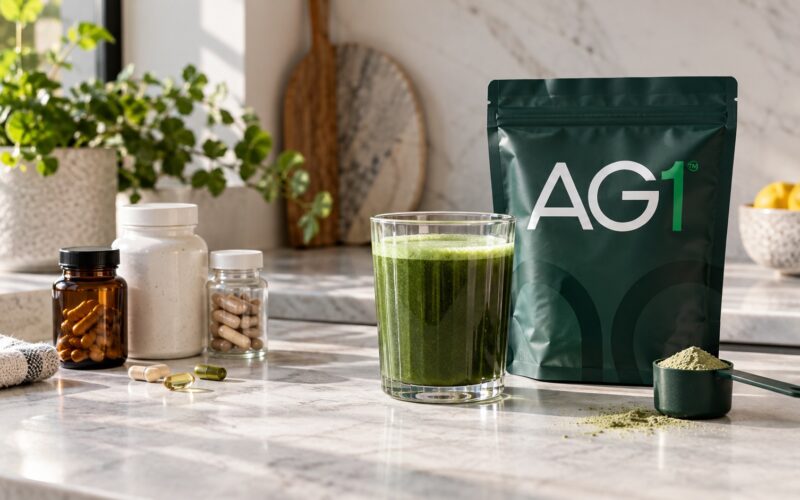
Is AG1 Worth It If You Already Take Vitamins? What You Actually Need to Know
If you’re anything like me, you probably have a little collection of vitamins and supplements somewhere in your kitchen.
A multivitamin here, some probiotics there, maybe vitamin D, magnesium, or whatever else you’ve added to your routine over the years.
And then there’s AG1.
You’ve probably seen it all over social media. One scoop of green powder mixed with water, and apparently your entire morning supplement routine becomes a lot simpler.
Sounds pretty convenient, right?
But if you’re already taking vitamins, there’s one question worth asking before spending the money:
Is AG1 actually worth it, or would you just be paying for nutrients you’re already getting?
Because at around $79 per month for the standard subscription, AG1 isn’t exactly an inexpensive habit.
So let’s look at what AG1 actually contains, how it compares to a regular multivitamin, and who might genuinely find it worth buying.
What Is AG1, and Why Is Everyone Taking It?
AG1, formerly known as Athletic Greens, is a powdered daily nutritional supplement that combines vitamins, minerals, probiotics, prebiotics, and plant-based ingredients into one drink.
Instead of swallowing several different pills in the morning, you mix one scoop with cold water.
The idea is pretty simple: make getting a variety of nutrients more convenient.
AG1’s newer formula, called AG1 Next Gen, includes:
- Essential vitamins such as A, C, E, and several B vitamins
- Minerals including zinc and selenium
- Probiotics and prebiotics
- Greens and plant-based ingredients
- Additional botanical compounds
One reason AG1 attracts so much attention is that it’s marketed as more than just a greens powder.
It’s designed to combine several supplement categories into one product.
And if you’re someone who already has five different bottles sitting on the kitchen counter, I can see why that sounds appealing.
But more ingredients don’t automatically mean better results.
What matters is whether those ingredients fill a nutritional need you actually have.
Is AG1 Worth It If You Already Take Vitamins?
Here’s the short answer: It can be, but not necessarily for the reasons you might think.
If you already take a good-quality multivitamin, eat a balanced diet, and don’t have any particular nutritional gaps, AG1 might not provide enough additional value to justify its price.
That’s the part that tends to get lost in supplement marketing.
Taking more vitamins doesn’t necessarily make you healthier.
In fact, the National Institutes of Health notes that while supplements can help people meet certain nutritional needs, taking multiple products can sometimes lead to excessive intake of particular nutrients.
But there’s another side to this.
If you’re taking several different supplements, struggling to maintain a consistent routine, or looking for an alternative to your current multivitamin, AG1 may be worth considering.
The key difference is whether you’re adding AG1 on top of everything you already take or using it to simplify your supplement routine.
Those are two very different situations.
AG1 vs Multivitamin: What’s the Difference?
At first glance, AG1 and a traditional multivitamin seem pretty similar.
Both provide a selection of vitamins and minerals.
But AG1 also contains additional ingredients, including probiotics, prebiotics, and plant compounds that aren’t typically found in basic multivitamins.
Here’s how they compare.
| Feature | AG1 | Traditional Multivitamin |
|---|---|---|
| Essential vitamins | Yes | Yes |
| Minerals | Yes | Yes |
| Probiotics | Included | Usually not included |
| Prebiotics | Included | Usually not included |
| Greens and plant compounds | Included | Usually not included |
| Cost | Relatively expensive | Usually more affordable |
| Convenience | One daily drink | Usually one or more pills |
| Replaces a healthy diet | No | No |
So is AG1 better than a multivitamin?
Not automatically.
If all you need is a basic multivitamin, spending significantly more on AG1 might not make sense.
However, if you’re interested in a product that combines several categories of supplements, AG1 offers something different.
The important thing to understand is that including probiotics and plant compounds doesn’t guarantee additional health benefits for everyone.
Their effectiveness depends on the specific ingredients, doses, and individual needs.
AG1 offers a broader combination of ingredients, but a broader ingredient list isn’t the same thing as proven superior health benefits.
Can AG1 Replace Your Daily Vitamins?
This is probably one of the biggest questions people have before trying AG1.
And the answer is: AG1 may be able to replace certain general supplements, but it shouldn’t automatically replace everything you take.
According to AG1, its formula is intended to serve as an alternative to several common daily products, including:
- General multivitamins
- Vitamin B-complex supplements
- Vitamin C supplements
- Certain probiotic supplements
- Greens powders
That’s part of what makes it appealing.
Instead of buying and remembering multiple products, you have one daily drink.
However, that doesn’t mean everybody should discontinue their existing vitamins.
For example, if your doctor recommended iron because of an iron deficiency, AG1 shouldn’t be treated as a replacement for that iron supplement.
The same applies to specific nutritional needs involving vitamin D, calcium, and other nutrients.
In fact, AG1 sells a separate vitamin D3 + K2 product, which is another reminder that its greens powder isn’t necessarily intended to provide every nutrient a person might need.
Before replacing your existing supplements, compare their labels with AG1’s current Supplement Facts panel.
Pay attention to both the nutrients and the amounts.
And if you’re taking something to address a diagnosed deficiency or medical condition, talk with your healthcare professional before changing it.
Can You Take AG1 and a Multivitamin Together?
Technically, some people may be able to take both, but that doesn’t mean it’s a good idea.
AG1 already contains substantial amounts of several vitamins, including vitamin C and certain B vitamins.
Adding another multivitamin could create unnecessary overlap.
And while some vitamins are generally well tolerated at higher amounts, others can cause problems when consistently consumed in excess.
This is especially important if you also take individual supplements throughout the day.
For most people considering AG1 as their main daily multinutrient supplement, the more useful question is:
Could AG1 replace my general multivitamin instead of being another product I add to my routine?
That approach makes more sense financially, too.
Otherwise, you could end up paying for two products that serve many of the same purposes.
How Much Does AG1 Cost, and Is It Worth the Money?
Let’s talk about the price, because this is where I think the decision becomes more personal.
At the time of writing, AG1 lists the following prices for its standard pouch:
| Purchase Option | Cost | Approximate Cost Per Serving |
|---|---|---|
| 30-day subscription | $79 | $2.63 |
| 90-day subscription | $207 | $2.30 |
| One-time purchase | $99 | $3.30 |
Prices are based on AG1’s published offers and may change.
If you choose the standard monthly subscription, you’re spending approximately $948 per year.
That’s a meaningful expense.
And if your only goal is to get basic vitamins and minerals, you can almost certainly find a less expensive option.
But price isn’t the only thing that determines value.
Think about what you’re currently spending on supplements.
Maybe you buy a multivitamin, probiotics, a greens powder, and a few other general wellness products.
If AG1 can appropriately replace some of those purchases, the difference in cost may be smaller than it initially looks.
On the other hand, if you’re only spending $15 per month on a multivitamin and are perfectly happy with it, AG1 becomes a much harder purchase to justify.
My advice? Compare AG1 with your actual supplement spending, not with an imaginary collection of products you wouldn’t otherwise buy.
That’s a much more useful way to decide whether the convenience is worth paying for.
Want to see whether AG1 makes sense for your routine?
You can check AG1’s current pricing, subscription options, and available welcome offers here.
I recommend looking at the full ingredient label and comparing it with any vitamins you’re already taking before deciding.
What Are the Actual Benefits of Taking AG1?
AG1 promotes several potential benefits related to foundational nutrition, gut health, and overall wellness.
But it’s important to separate what its ingredients are intended to do from what has been demonstrated in scientific studies.
1. It may help fill certain nutritional gaps
Some people consistently fall short on particular vitamins or minerals.
A multinutrient supplement may help address some of those gaps, depending on what the product contains and what the person actually needs.
AG1 includes a broad selection of micronutrients, making this one of its more straightforward potential advantages.
However, it doesn’t mean every person who takes AG1 needs all those nutrients.
2. It includes ingredients intended to support gut health
AG1 contains probiotics and prebiotics, which are ingredients often associated with digestive and gut health.
Probiotics are live microorganisms that may provide certain benefits when consumed in adequate amounts.
Prebiotics are substances used by beneficial microorganisms in the gut.
But not all probiotics work the same way, and including them in a supplement doesn’t guarantee improvements in digestion or bloating.
AG1 has also publicized research examining aspects of its formula and gut microbiome.
That’s worth considering, but changes in gut bacteria don’t automatically mean someone will experience noticeable digestive benefits.
3. It simplifies your morning routine
This might not sound like the most exciting benefit, but I think it’s one of the more practical ones.
A supplement only becomes part of your routine if you actually remember to take it.
And for some people, a single drink may be easier to incorporate consistently than keeping track of several bottles.
Especially if mornings already feel rushed.
Of course, other people find swallowing one multivitamin much easier than preparing a drink.
Neither approach is inherently better. It really comes down to which one you’ll consistently use.
4. It may be convenient when traveling
If you travel regularly, keeping track of multiple supplements can get annoying.
AG1 also offers individual travel packs, which can be easier to carry than a collection of bottles.
That doesn’t make it nutritionally superior, but convenience is still a legitimate factor when choosing a product.
Is AG1 Good for Women Over 30?
If you’re a woman in your 30s or 40s, it’s easy to feel like there’s always another supplement you’re supposed to be taking.
One for your energy. One for your gut. Another for your skin, hormones, or recovery.
And suddenly your supplement routine starts looking like an entire pharmacy.
But turning 30 doesn’t automatically mean you need a complicated supplement routine.
Your nutritional needs depend on factors like your diet, health, activity level, medications, and whether you’re pregnant or planning a pregnancy.
AG1 may appeal to women who want a convenient way to supplement their diet without managing several general wellness products.
However, it isn’t specifically designed to meet every nutritional need women may have.
For example, women with iron deficiency, pregnancy-related nutrient requirements, or other specific health needs may require different supplements.
AG1 also states that its product isn’t intended for pregnant or nursing women.
So while AG1 might fit into some women’s routines, I wouldn’t recommend buying it simply because you’re over 30.
I’d recommend evaluating what you actually need first.
Who Is AG1 Actually Worth It For?
After looking at the ingredients, price, and what AG1 is designed to do, I think there are a few situations where it may make sense.
AG1 may be worth considering if:
- You want to simplify a complicated general supplement routine.
- You prefer drinking a supplement rather than taking multiple pills.
- You’re interested in a combination of vitamins, minerals, probiotics, and plant ingredients.
- You value convenience enough to pay more for it.
- You can comfortably fit the monthly cost into your budget.
AG1 might not be worth it if:
- You already meet your nutritional needs through food and appropriate supplements.
- You’re happy with an affordable multivitamin.
- You’re primarily looking for a solution to fatigue, digestive symptoms, or another medical concern.
- You expect AG1 to replace vegetables or a balanced diet.
- The monthly cost would strain your budget.
That last one matters.
You don’t need to spend nearly $80 a month on a greens powder to be a healthy person.
There are plenty of ways to support your nutrition without buying an expensive supplement.
But if the product fits your needs, preferences, and budget, convenience can be worth paying for.
Is AG1 Worth Trying for 30 Days?
If you’ve been considering AG1 for a while, you might be wondering whether trying it for a month is a reasonable way to make up your mind.
I think that’s fair, as long as your expectations are realistic.
You might notice differences in how convenient your routine feels, or you might not notice anything particularly dramatic.
And that’s okay.
Vitamins aren’t supposed to work like energy drinks.
Not feeling an immediate difference doesn’t necessarily mean a product is useless. But feeling better after starting a supplement also doesn’t prove that the supplement caused the improvement.
Diet, sleep, stress, training, and plenty of other factors influence how we feel.
AG1 currently advertises a 90-day money-back guarantee on qualifying purchases, along with subscription options that can be paused or canceled.
If you’re considering trying it, review the current terms directly before ordering.
See AG1’s current subscription options and offers here.
Frequently Asked Questions About AG1
Do I still need a multivitamin if I take AG1?
AG1 is designed to provide many nutrients commonly found in multivitamins, so some people may not need to take both. However, check the Supplement Facts label and consult your healthcare professional about any specific nutrient needs.
Does AG1 replace vitamin D?
Don’t assume that it does. AG1 also offers a separate vitamin D3 + K2 supplement. If you’re taking vitamin D for a diagnosed deficiency or on medical advice, don’t discontinue it simply because you’ve started AG1.
Is AG1 better than regular vitamins?
Not necessarily. AG1 combines vitamins and minerals with probiotics, prebiotics, and other ingredients, but that doesn’t mean it’s better for everyone. A traditional multivitamin may be sufficient for someone who only needs basic nutritional supplementation.
Can you take AG1 every day?
AG1 is designed for daily use according to its directions. However, daily use isn’t appropriate for everyone, particularly people with certain health conditions, medications, or other supplement combinations.
Is AG1 worth $79 a month?
It depends on what you’re replacing and what you value. If convenience and combining several supplement categories matter to you, the price may be reasonable. If you’re only looking for an inexpensive multivitamin, there are more affordable choices.
Does AG1 replace eating vegetables?
No. Greens powders don’t provide all the benefits of eating whole vegetables, including the full range of fiber, water, and food components found in a varied diet.
Does AG1 help with bloating?
AG1 contains ingredients associated with digestive health, but results vary. Some people may tolerate it well, while others may experience digestive discomfort. It shouldn’t be treated as a solution for persistent bloating or unexplained digestive symptoms.
Final Verdict: Is AG1 Worth It If You Already Take Vitamins?
So, would I recommend buying AG1 if you’re already taking vitamins?
I think it’s worth considering as a replacement for certain general supplements, not automatically as an addition to everything you’re already taking.
That’s the distinction that matters most.
AG1 isn’t a magic drink, and it isn’t something everybody needs.
If you’re getting the nutrients you need, feeling good, and happy with your existing routine, there may be no compelling reason to switch.
But if your supplement routine has become expensive, inconvenient, or difficult to keep up with, AG1 could be an option worth comparing.
I like the idea of simplifying things when it genuinely makes life easier.
I just don’t believe in spending more money on supplements for the sake of having more supplements.
If you’ve been curious about AG1, start by looking at the ingredients and comparing them with what you’re already taking.
That will tell you a lot more than another viral morning-routine video.
And if it does look like a good fit, you can check the latest AG1 pricing and available offers here.
Sometimes the best wellness routine isn’t the one with the most products.
It’s the one that makes sense for your actual life.
Disclaimer: This article is for informational purposes only and isn’t intended to replace professional medical advice. Always consult a qualified healthcare professional before starting or changing supplements, especially if you take medications, have a medical condition, or have been diagnosed with a nutritional deficiency.